
Not every workshop needs to stay heated all winter.
Maybe you have a detached garage where you work on vehicles, a pole barn where you tackle weekend projects, or a woodworking shop you only use a few evenings each week.
You don’t necessarily want to pay to keep the building at 65°F every day. You just want to turn on the heat when you’re ready to work and have the space become comfortable without wasting energy.
That raises an important question:
What is the best insulation for a workshop you only heat occasionally?
The answer depends on how the building is constructed, what type of heating system you use, and how often you plan to use the space.
For many workshops, spray foam insulation is worth considering because it can help reduce air leakage while providing thermal insulation. But fiberglass and cellulose can also be effective when they’re installed as part of an appropriately designed assembly.
Here’s what to consider before making a decision.
Why Insulation Matters Even If You Don’t Heat Your Workshop Every Day
If your workshop isn’t heated continuously, you might wonder whether insulation is worth the investment.
After all, why insulate a building that sits cold most of the week?
The answer comes down to what happens when you turn on the heat.
In an uninsulated workshop, heat can escape quickly through the walls, roof, ceiling, and gaps in the building envelope.
A heater may warm the air, but the building can continue losing that heat as fast as the equipment produces it.
Insulation helps slow heat transfer between the inside and outside of the building.
When combined with effective air sealing, it can help:
- Reduce heat loss while the workshop is being heated
- Make indoor temperatures easier to maintain during use
- Reduce the heating energy needed to maintain a comfortable temperature
- Improve comfort near exterior walls and other building surfaces
- Make the workshop more practical to use throughout the year
There’s one important distinction: insulation doesn’t generate heat or guarantee that a cold building will warm up quickly.
The size of the building, heating equipment, air leakage, and temperature of the floors, tools, and other materials all affect how long it takes to feel comfortable.
But a properly insulated building generally requires less heating energy to maintain a given indoor temperature than a comparable poorly insulated building.
What Is the Best Insulation for an Occasionally Heated Workshop?
There isn’t one insulation material that’s automatically best for every workshop.
The right choice depends on the building’s construction, your budget, and how the space will be used.
Closed-Cell Spray Foam Insulation
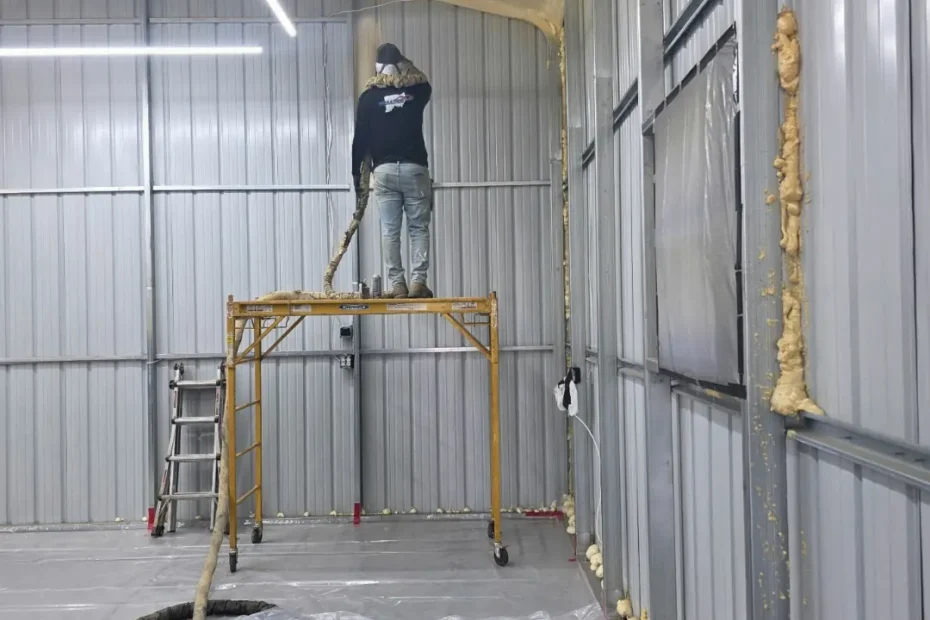
Closed-cell spray foam is a common option for workshops, garages, and metal buildings.
It expands when applied and adheres to many properly prepared surfaces, creating an insulation layer that can also help reduce air leakage.
Benefits may include:
- Insulation and air sealing in one application
- High thermal resistance per inch
- Application to many wall and roof assemblies
- Reduced air movement through the insulated areas
- Potential condensation-control benefits when used in a properly designed assembly
Closed-cell spray foam can be especially useful in buildings with limited cavity depth or areas where air leakage is difficult to address with traditional insulation alone.
However, the correct thickness and assembly design matter. Metal buildings, in particular, require attention to condensation, moisture movement, and thermal bridging.
Closed-cell spray foam also generally costs more upfront than fiberglass insulation.
Open-Cell Spray Foam Insulation
Open-cell spray foam is another option for certain workshop assemblies.
Like closed-cell spray foam, it expands to fill cavities and can provide air sealing when installed at the appropriate thickness.
Open-cell foam generally has a lower R-value per inch than closed-cell foam and different vapor-permeance characteristics.
That means it isn’t interchangeable with closed-cell foam in every building.
Whether open-cell spray foam is appropriate depends on the wall or roof assembly, moisture conditions, and applicable building requirements.
Fiberglass Insulation
Fiberglass batts are another common insulation option for workshops with framed walls and ceilings.
They can be cost-effective and provide good thermal performance when installed correctly.
However, fiberglass batts don’t function as an air barrier by themselves.
If the building has gaps around framing, penetrations, doors, or other openings, air leakage can continue even after insulation is installed.
For fiberglass to perform well, the surrounding assembly needs appropriate air sealing and moisture control.
In metal buildings, fiberglass insulation also requires careful attention to compression, support, condensation control, and the overall assembly design.
Blown-In Cellulose Insulation
Cellulose can be a practical option for certain workshop applications, particularly enclosed ceilings, attic spaces, and suitable wall assemblies.
Blown-in cellulose can provide good coverage across large attic areas, while dense-packed cellulose may be used in certain enclosed cavities.
Like fiberglass, cellulose insulation should be installed as part of a properly air-sealed assembly.
The best application depends on whether the workshop has an accessible attic, framed walls, or another type of construction.
Why Air Sealing Is Especially Important in a Workshop
One of the biggest factors affecting workshop comfort isn’t just how much insulation you install.
It’s how much heated air can escape.
Workshops often have features that create air-leakage opportunities, including:
- Large overhead garage doors
- Gaps around windows and exterior doors
- Openings where electrical wiring or plumbing passes through walls
- Connections between walls and roof assemblies
- Gaps around framing and other construction joints
When the heater is running, uncontrolled air leakage can make it harder to maintain a comfortable temperature.
This is particularly noticeable in a workshop that isn’t heated continuously.
You may spend time and energy warming the space, only to lose conditioned air through openings in the building envelope.
A well-planned insulation project should consider both the insulation and the air barrier.
Even with excellent wall insulation, a poorly sealed overhead door can remain a significant source of heat loss.
Should You Insulate the Walls or Ceiling First?
This depends on how your workshop is built.
For example, a detached garage with a flat ceiling and an attic above it may have different insulation priorities than a pole barn with exposed roof framing.
Workshops With Attics
If the workshop has a ceiling separating the heated space from an unconditioned attic, insulating and air sealing the ceiling plane is often an important part of the project.
The goal is to establish a continuous thermal boundary around the space you intend to heat.
Workshops With Exposed Roof Decks
If the workshop has an open ceiling and the roof deck forms part of the conditioned enclosure, insulation may be installed at the roof assembly instead.
The correct approach depends on the roof design, ventilation strategy, moisture-control requirements, and insulation system.
Exterior Walls
Exterior walls also need to be considered, especially when the workshop will be heated regularly during use.
The insulation should work together with the ceiling or roof insulation to create a reasonably continuous thermal boundary.
Rather than choosing one area based on a general rule, it’s better to evaluate how the entire building is constructed.
What About Metal Workshops and Pole Barns?
Metal buildings deserve special consideration.
Metal panels respond quickly to outdoor temperature changes, and metal framing can conduct heat through the building envelope.
Condensation can also become a concern when warm, moisture-containing indoor air contacts cold surfaces.
This is especially relevant in workshops where heating is turned on and off.
The building may experience large temperature changes as it moves between unheated and heated conditions.
That doesn’t mean spray foam is automatically the only option.
It does mean the insulation system should be selected with the building’s construction, moisture conditions, and intended use in mind.
For some metal workshops, closed-cell spray foam may be a strong option because it can provide insulation, reduce air leakage, and contribute to condensation control when properly designed and installed.
For others, different insulation assemblies may be appropriate.
The key is understanding the building before choosing the material.
Does Insulation Help a Workshop Warm Up Faster?
This is a common question, especially for people who only use their workshops on weekends.
Insulation primarily slows heat transfer. It doesn’t increase the amount of heat produced by your heater.
When you turn on the heat in a cold workshop, the heating system has to warm the air while also overcoming heat losses and warming colder surfaces and objects.
Insulation and air sealing can reduce ongoing heat loss, which helps the heating system work toward and maintain the desired temperature.
However, the time it takes to warm the building also depends on:
- The capacity and type of heating system
- Outdoor temperature
- Building size and ceiling height
- Air leakage
- The temperature and thermal mass of the concrete floor
- Tools, equipment, vehicles, and other materials stored inside
A workshop with a large concrete slab may still take time to feel comfortable, even with well-insulated walls and ceilings.
If fast warm-up is a major priority, the heating system and insulation strategy should be planned together.
Is It Worth Insulating a Workshop You Only Use on Weekends?
It can be.
The financial return depends on how often you heat the building, your energy costs, the insulation investment, and the condition of the existing structure.
If you only use the workshop a few times each winter, the energy savings alone may take longer to offset the upfront cost.
But if you’re working in the space regularly, even without keeping it heated around the clock, insulation may provide meaningful comfort and operating-cost benefits.
It’s also worth thinking about how your needs could change.
Maybe today you only work in the garage on Saturdays.
A few years from now, you might use it as a woodworking shop, home business workspace, or year-round hobby area.
Planning the insulation correctly now may help you avoid additional work later.
What Should You Consider Before Choosing Workshop Insulation?
Before requesting an estimate, think about how you intend to use the building.
How often will you heat it?
A workshop used every evening may have different needs than one used twice a month.
What temperature do you want to maintain while working?
There’s a difference between taking the chill off and maintaining a comfortable indoor temperature for several hours.
What type of heating system will you use?
Forced-air heating, radiant heating, and other systems may affect how the space is used and how quickly it feels comfortable.
How is the building constructed?
Framed walls, metal panels, exposed roof decks, attic spaces, and overhead doors all affect insulation decisions.
Will the workshop eventually be cooled, too?
If you’re considering adding air conditioning in the future, it’s worth including that possibility in your insulation plan.
Are there special ventilation needs?
Workshops used for painting, welding, woodworking, vehicle maintenance, or other activities may require dedicated ventilation and safety measures. Insulation and air sealing should not replace necessary ventilation.
Frequently Asked Questions
Is spray foam worth it for a detached workshop?
Spray foam may be worth considering when air sealing, limited cavity depth, or the building’s construction makes it a good fit. The value depends on the size of the project, intended use, and available alternatives.
Can you insulate a workshop without heating it all winter?
Yes. Insulation can still provide benefits when a building is heated only during use. It helps reduce heat transfer, although it won’t keep an unheated building permanently warm.
Is closed-cell spray foam better than fiberglass for a metal workshop?
Closed-cell spray foam may offer advantages in certain metal building assemblies, particularly where air sealing and condensation control are important. However, fiberglass systems can also be effective when properly designed and installed.
Should you insulate the roof or ceiling of a workshop?
It depends on the building design and where the thermal boundary belongs. Workshops with attics may be insulated at the ceiling, while open-roof structures may require a roof-level insulation strategy.
Will insulation keep an unheated workshop above freezing?
Not reliably. Insulation slows heat transfer but doesn’t create heat. Without a heat source, an unheated workshop can eventually reach freezing temperatures during prolonged cold weather.
Planning to Insulate Your Workshop, Garage, or Pole Barn?
Whether you’re building a new workshop or improving an existing space, the best insulation choice depends on how the building is constructed and how you plan to use it.
At Insulation Hub, we work with homeowners and property owners throughout Indiana and West Central Ohio on insulation projects for garages, workshops, pole barns, and other buildings.
Our team can help evaluate your space, explain the available insulation options, and recommend an approach that fits your project.
Ready to make your workshop more comfortable when you need it? Call Insulation Hub at 317-385-5456 to discuss your project and request an insulation estimate.