
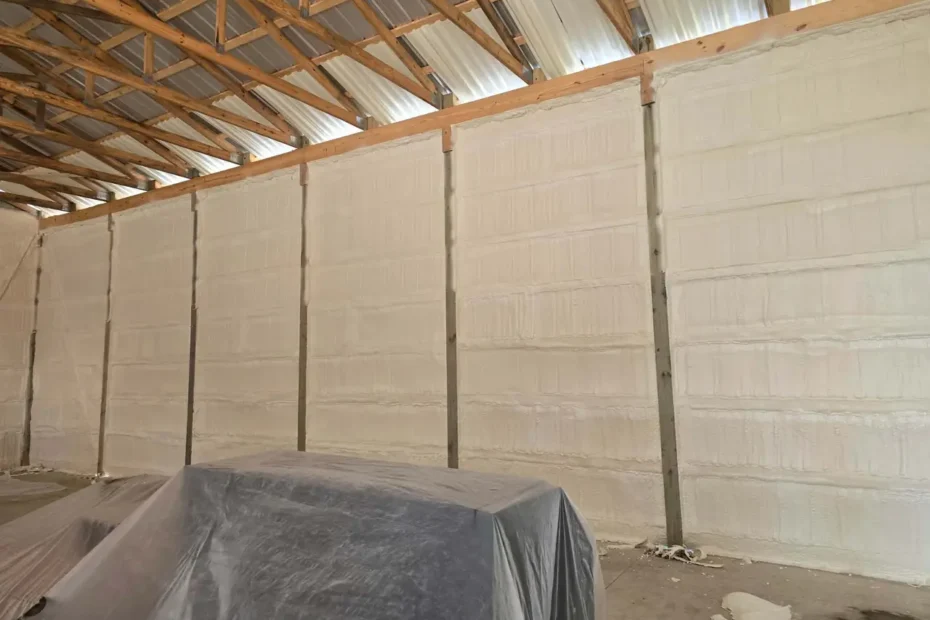
When homeowners compare spray foam insulation estimates, one of the most important details is how much foam will be installed.
You might see a quote for two inches of closed-cell spray foam on a wall or several inches of foam beneath a roof deck.
But does thicker always mean better?
Spray foam can be installed too thin for the intended thermal performance, and applying too much foam in a single pass can violate a product’s installation requirements. The right application depends on the specific foam, building assembly, and performance requirements.
Why Spray Foam Thickness Matters
Insulation slows the transfer of heat through walls, ceilings, floors, and other building surfaces.
Its resistance to heat flow is measured by R-value.
For a particular spray foam product, increasing the installed thickness generally increases the R-value.
However, not all spray foam products provide the same R-value per inch.
Open-cell and closed-cell spray foam have different characteristics, and even products within the same category may have different published performance values.
That is why contractors should use the specific product’s documentation rather than assume every foam performs identically.
What Happens If Spray Foam Is Too Thin?
If spray foam is installed below the specified thickness, the completed assembly may not provide the intended thermal resistance.
The consequences depend on the building and application.
Potential concerns include:
- Lower-than-specified insulation performance
- Incomplete coverage
- Failure to meet applicable project requirements
- Differences between the estimate and completed installation
- Moisture-control implications in certain assemblies
Thickness can also influence whether particular closed-cell foam products provide the vapor-control characteristics required for an assembly.
This is one reason insulation recommendations should account for the building’s construction and climate.
Can Spray Foam Be Too Thick?
Yes, particularly when too much foam is applied in a single pass.
Professional spray foam installers often apply material in controlled layers called lifts.
Manufacturers establish application requirements that may include maximum lift thickness, waiting periods, substrate conditions, and other limitations.
Some products allow different lift thicknesses than others.
Applying foam outside those requirements can create excessive heat during the curing process and may contribute to defects or other safety concerns.
Importantly, a total design thickness achieved through approved multiple lifts is not the same as exceeding a product’s maximum thickness in one pass.
What Is a Spray Foam Lift?
A lift is a layer of spray foam applied during installation.
Depending on the product and project, an installer may need multiple lifts to achieve the specified total thickness.
The installer must follow the manufacturer’s instructions regarding application thickness, timing, and conditions.
This is a technical part of the job that homeowners may never see once the insulation is covered.
Is Two Inches of Closed-Cell Spray Foam Enough?
There is no universal answer.
Two inches may be appropriate for certain applications, but it is not automatically sufficient for every wall, roof, or floor assembly.
The required thickness depends on factors such as:
- The foam product and its tested R-value
- Whether the application is a wall, roof, floor, or rim joist
- Local code requirements
- Climate zone
- Whether other insulation materials are included
- Air, moisture, and vapor-control requirements
- The intended use of the building
A garage, pole barn, basement, and new home may all require different approaches.
How Should Homeowners Compare Spray Foam Quotes?
When reviewing estimates, ask contractors to identify the foam type, product, application areas, and proposed thickness.
If two contractors recommend different thicknesses, ask each to explain the assembly design and performance target.
A quote that specifies more foam is not automatically the better solution. The important question is whether the installation is appropriate for the building and follows the product’s requirements.
Why Professional Installation Matters
Spray foam installation involves more than selecting an R-value.
Installers must understand the equipment, material, substrate conditions, application thickness, and curing requirements.
At Insulation Hub, Nathan is a Certified Master Installer and Lane is a Certified Installer through the Spray Polyurethane Foam Alliance’s Professional Certification Program.
These qualifications are part of the company’s investment in professional installation knowledge.
Frequently Asked Questions
What is the recommended thickness for spray foam insulation?
It depends on the foam product, building location, climate zone, code requirements, and intended assembly. There is no single correct thickness for every project.
Does thicker spray foam always mean a higher R-value?
For the same product, greater thickness generally provides greater R-value. However, overall performance also depends on proper installation and the building assembly.
What happens if spray foam is sprayed too thick in one pass?
Exceeding manufacturer application limits can lead to excessive heat during curing and potentially cause material defects or safety problems.
What is the difference between lift thickness and total thickness?
Lift thickness refers to one application layer. Total thickness is the combined installed thickness, which may be achieved through multiple approved lifts.
Is closed-cell spray foam always better than open-cell foam?
No. Each has different properties and suitable applications. The best choice depends on the project.
Get the Right Insulation for Your Building
The goal of spray foam installation isn’t to use the greatest amount of material possible.
It’s to install the appropriate product at the appropriate thickness for the building.
Insulation Hub helps property owners throughout Indiana and West Central Ohio evaluate insulation options for homes, garages, pole barns, and commercial buildings.
Call 317-385-5456 to discuss your insulation project.