
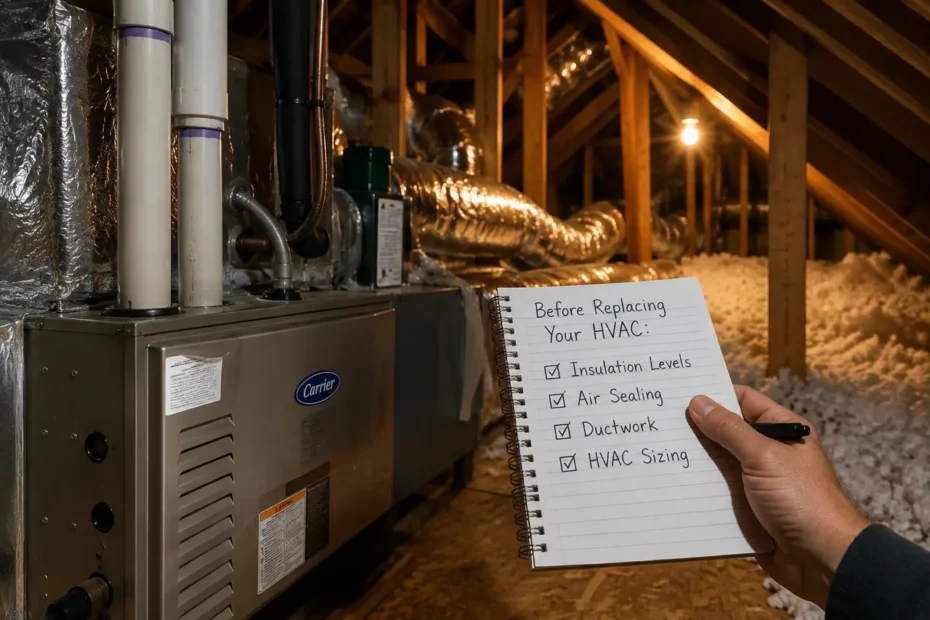
If your heating or cooling system is struggling to keep your home comfortable, replacing the HVAC equipment can seem like the obvious solution.
But before investing in a new furnace, air conditioner or heat pump, there is another part of your home worth evaluating: The building envelope.
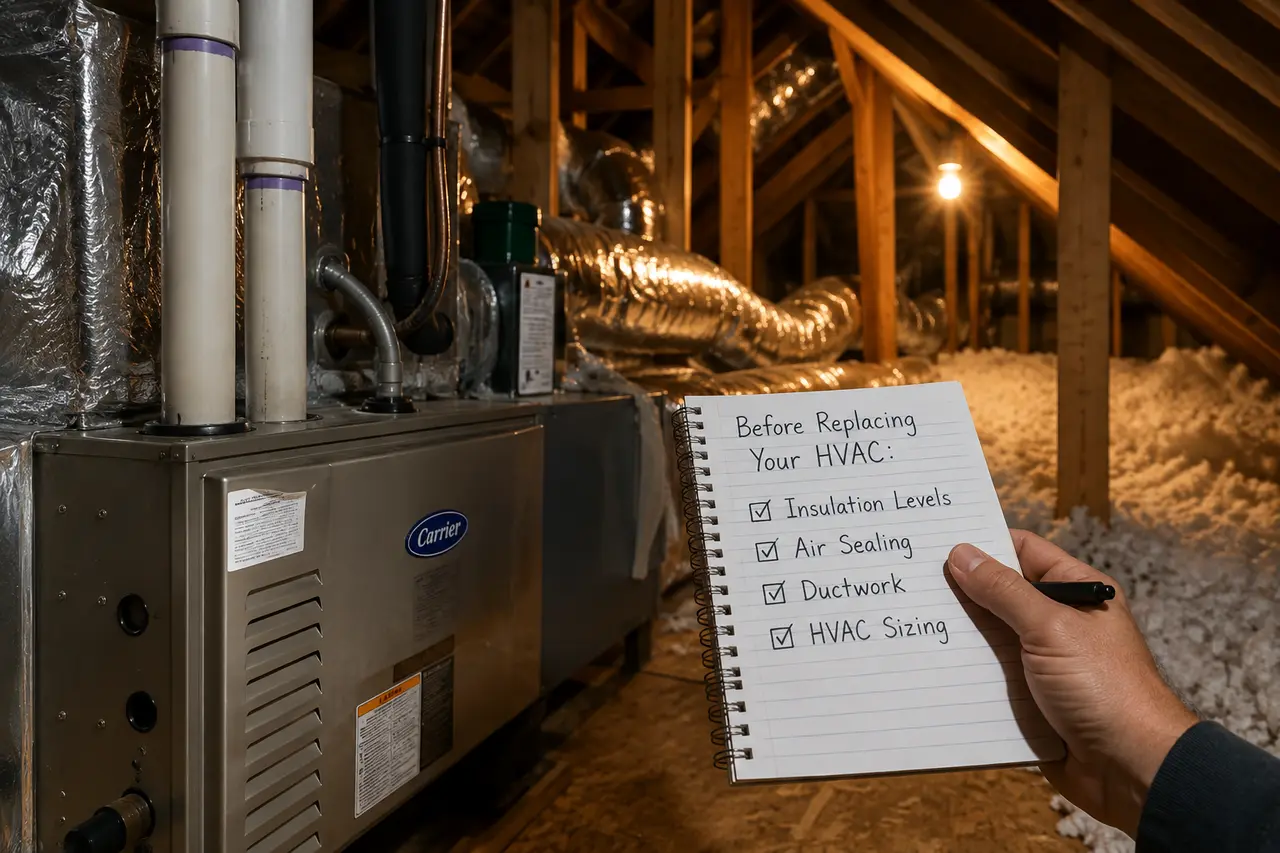
Your HVAC system and your home’s insulation work together. The equipment heats or cools the air, while the building envelope helps control how quickly that conditioned air—and the heat associated with it—is lost or gained.
If your home has inadequate insulation or significant air leakage, installing new HVAC equipment without addressing those issues may mean the new system is still fighting the same underlying problem.
Why Insulation Matters to Your HVAC System
Your HVAC system is designed to handle a certain heating and cooling load.
That load is influenced by factors such as:
- The size and layout of the home
- Windows and doors
- Air leakage
- Insulation levels
- Sun exposure
- Local climate
- Ductwork
- Indoor temperature goals
When a home has a weak thermal or air boundary, more heat can enter during the summer and escape during the winter.
The HVAC system then has to work harder to maintain the temperature you want.
That’s why an HVAC problem isn’t always only an HVAC problem.
Signs Your Insulation Should Be Evaluated Before Replacing Your HVAC
If your HVAC equipment is old or has failed mechanically, replacement may be necessary regardless of the home’s insulation.
But there are some symptoms that warrant taking a closer look at the building envelope before assuming new equipment will solve everything.
These include:
- Upstairs rooms that are consistently hotter than downstairs
- Certain bedrooms that never seem comfortable
- Cold floors during the winter
- Drafts
- Large temperature differences between rooms
- An HVAC system that runs for long periods
- High heating or cooling bills
- Rooms over garages that are especially uncomfortable
- A home that quickly becomes hot or cold when the HVAC shuts off
Insulation, air leakage, ductwork and HVAC performance can all contribute to these symptoms.
The goal is to determine why the home is uncomfortable before deciding what needs to be replaced.
Why This Matters Before Your New HVAC System Is Sized
HVAC contractors use the heating and cooling demands of a home to determine how much capacity the equipment needs.
If you’re planning significant improvements to your building envelope, those improvements can change the home’s heating and cooling load.
For example, adding needed attic insulation and addressing major air leakage may reduce the amount of heat entering the house during summer or escaping during winter.
That doesn’t automatically mean you’ll need a smaller HVAC system. Equipment sizing depends on the entire home and should be determined by a qualified HVAC professional using an appropriate load calculation.
But it is one reason insulation and HVAC decisions shouldn’t always be made independently.
Ideally, the HVAC contractor should be sizing equipment for the home you’re going to have after improvements, not simply compensating for building-envelope deficiencies you intend to fix.
Don’t Automatically Assume Bigger HVAC Equipment Is Better
When a home struggles to stay comfortable, homeowners sometimes assume they need a larger system.
Bigger isn’t automatically better.
Oversized HVAC equipment can introduce its own performance problems, including short cycling and, particularly with cooling equipment, less effective humidity control.
If the actual problem is heat entering through an under-insulated attic, air leaking through gaps in the building envelope or poorly insulated areas around the home, simply adding more HVAC capacity doesn’t correct those deficiencies.
You’re asking the mechanical system to compensate for a building-envelope problem.
Sometimes the HVAC System Really Is the Problem
Insulation isn’t the answer to everything.
An HVAC professional may identify issues such as:
- Aging or failing equipment
- Refrigerant or mechanical problems
- Improper system sizing
- Leaky or poorly designed ductwork
- Airflow problems
- Dirty or restricted components
That’s why good diagnosis matters.
At Insulation Hub, the goal isn’t to tell every homeowner they need more insulation. It’s to evaluate the parts of the building envelope we specialize in and determine whether they are contributing to the problem.
What Should You Do First?
If your HVAC system still operates but you’re considering replacement because your house is uncomfortable or expensive to heat and cool, consider having the building envelope evaluated before making the final decision.
An insulation assessment can look at:
- Existing insulation levels
- Missing or inadequate insulation
- Air leakage
- Attic conditions
- Crawl spaces and rim joists
- Areas separating conditioned and unconditioned space
- Moisture concerns
- Other visible building-envelope issues
You can then take that information to your HVAC contractor when discussing replacement and equipment sizing.
The Bottom Line
Should you insulate before replacing your HVAC system?
Sometimes.
If the HVAC equipment has reached the end of its life, you may need new equipment regardless. But if the primary complaint is comfort, high energy use or a system that can’t seem to keep up, it makes sense to understand the home’s insulation and air leakage before assuming replacement alone will solve the problem.
Your HVAC system creates comfortable air.
Your building envelope helps keep the conditions you’re paying to create.
If you’re in Indiana or Ohio and aren’t sure whether insulation is contributing to your home’s comfort problems, Insulation Hub can evaluate your building envelope and help identify where improvements may make sense.
Frequently Asked Questions
Should I replace my HVAC system or insulation first?
It depends on the condition of both. Failed or unsafe HVAC equipment may need immediate replacement. If the system still works but the home is uncomfortable or inefficient, evaluating insulation and air leakage before replacement can provide useful information for the HVAC contractor.
Can better insulation reduce the size of HVAC system I need?
Building-envelope improvements can reduce heating and cooling loads, but HVAC equipment should be sized using a professional load calculation. Insulation is one of several factors that affect that calculation.
Will adding insulation make my air conditioner work less?
Proper insulation can reduce heat transfer into the home during hot weather, which can reduce the cooling load. Air sealing can also be important when uncontrolled air leakage is present.
Can insulation fix a room that’s always hotter than the rest of the house?
Sometimes. Missing insulation, attic conditions, rooms over garages and air leakage can contribute to temperature differences. Ductwork, airflow, solar exposure and HVAC design can also be responsible, so the cause should be investigated first.
Should I have my insulation inspected before buying a new furnace or AC?
If comfort or energy use is part of the reason you’re replacing the system, an insulation assessment can be valuable before final equipment decisions are made.