
If you’re planning to turn a pole barn into a workshop, garage, hobby space, agricultural workspace or conditioned building, it’s easy to get excited about the finished interior.
Walls go up. Lighting gets installed. Heat or air conditioning gets added. Equipment gets moved in.
But there’s one decision that’s much easier to make before you cover the framing:
How are you going to insulate the building?
Insulation can sometimes be added to an existing finished pole barn, but waiting until after interior finishes are installed can limit access and potentially make the project more complicated.
When Should You Insulate a Pole Barn?
Ideally, the insulation strategy should be considered before the interior wall and ceiling finishes are installed.
That doesn’t mean insulation is always the very next step after the exterior shell is built.
The correct sequence depends on the building design, insulation system, moisture strategy and other mechanical or electrical work.
But you want to answer important building-envelope questions before covering the assemblies.
For example:
- Will the building be heated?
- Will it be air-conditioned?
- Will it be conditioned occasionally or every day?
- How will moisture be managed?
- Where will the thermal boundary be?
- What type of insulation will be used?
- Is condensation a concern?
- Will plumbing be located inside the building?
- Are you finishing the ceiling or insulating at the roof deck?
Those decisions can influence the insulation approach.
Why Pole Barn Insulation Requires Planning
Pole barns and other metal buildings present some different challenges than traditional houses.
Metal is highly conductive.
When warm, humid air comes into contact with a sufficiently cold metal surface, condensation can form.
That’s why some unconditioned or poorly designed metal buildings develop the familiar problem owners describe as the building “sweating.”
Adding heating or cooling can change the temperature and moisture dynamics even further.
Insulation shouldn’t simply be treated as material stuffed behind a finished wall.
The entire assembly needs to manage heat, air and moisture.
What Happens If You Finish the Interior First?
Imagine installing metal liner panels, plywood, OSB or drywall over the entire interior and then deciding the building needs insulation.
The framing cavities that were once completely accessible are now covered.
Insulating may still be possible depending on the building, but the options can become more limited and the work may become more involved.
That’s why it’s worth calling an insulation contractor while the framing is accessible.
You may discover that there are details that should be addressed before they’re hidden.
What Type of Insulation Should You Use in a Pole Barn?
There isn’t one answer that’s correct for every building.
Options can include:
Closed-Cell Spray Foam
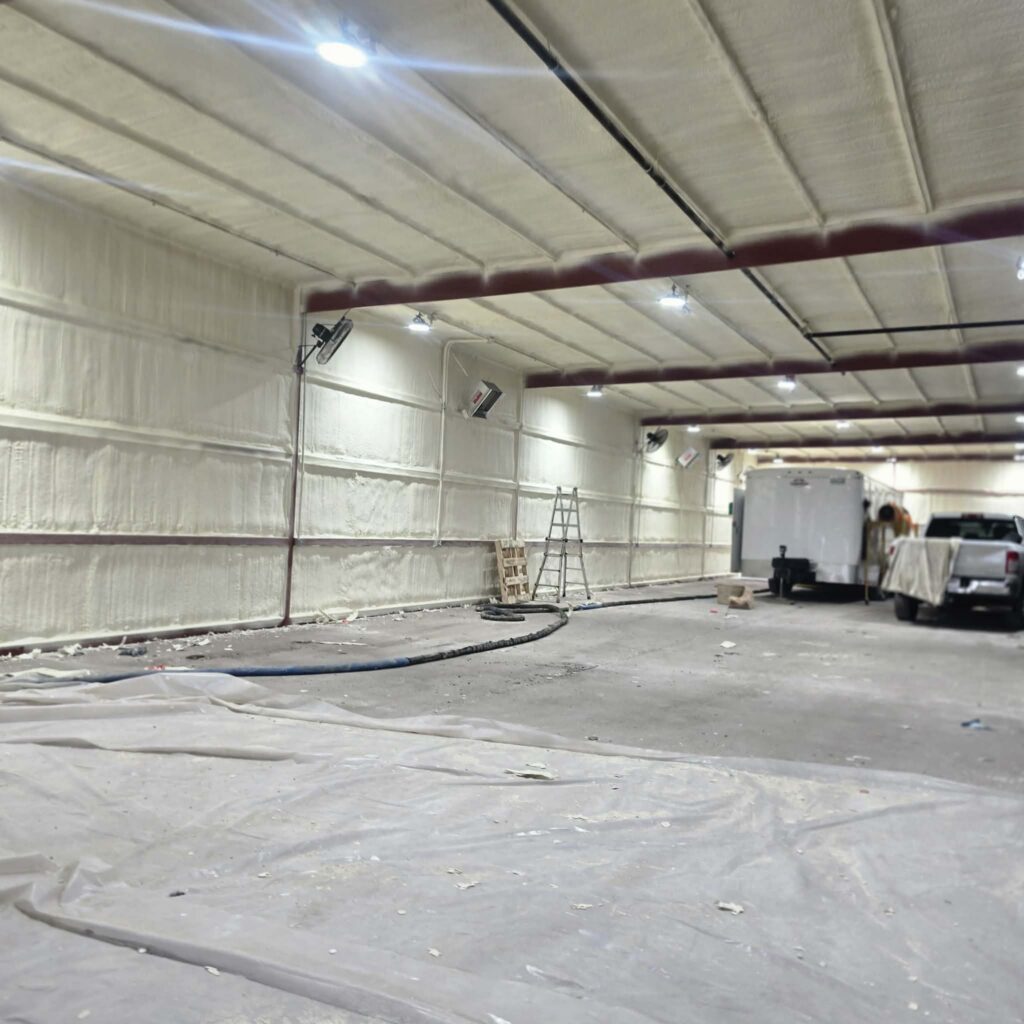
Closed-cell spray foam can provide insulation and air control in one system and is frequently considered for metal buildings.
It can also help control condensation when the assembly is designed and installed correctly.
Open-Cell Spray Foam
Open-cell spray foam can be appropriate in certain assemblies, but its vapor characteristics differ substantially from closed-cell foam.
The climate, substrate, location of the foam and intended use of the building all matter.
Fiberglass
Fiberglass can also be used successfully in pole barns, but the entire wall or roof assembly needs to account for air movement and moisture.
Simply filling cavities with fiberglass without considering air and vapor control can create performance problems.
The question shouldn’t only be:
“Which insulation has the highest R-value?”
It should be:
“What insulation assembly makes sense for this building?”
Will the Pole Barn Be Heated or Cooled?
This is one of the first things your insulation contractor should know.
An unconditioned agricultural storage building behaves differently from a shop maintained at a comfortable temperature throughout an Indiana or Ohio winter.
Likewise, a building that will eventually have air conditioning needs to deal with summer heat and humidity differently from an open equipment shed.
How you plan to use the building matters.
Tell your insulation contractor about future plans even if the HVAC equipment isn’t being installed immediately.
What About the Ceiling or Roof?
Don’t forget what’s above you.
You may have several possible approaches depending on the building design, including creating a thermal boundary at the ceiling or insulating along the roofline.
Those choices can affect:
- Conditioned volume
- Ventilation strategy
- Mechanical systems
- Moisture behavior
- Energy use
This is another reason to establish the insulation plan before finishing everything underneath it.
What If My Pole Barn Is Already Finished?
Don’t assume you’ve missed your opportunity.
Existing buildings can often be improved.
The contractor first needs to understand how the building was constructed and what access remains available.
In some cases, portions of the interior may need to be removed or accessed differently. In others, there may be viable retrofit approaches.
An inspection is the best way to determine what is practical.
Plan the Building Envelope Before You Cover It
The easiest time to solve many insulation problems is before they become hidden problems.
If you’re building or finishing a pole barn, shop or metal building, involve an insulation contractor before installing all of the interior finishes.
That allows the building’s insulation, air control and moisture strategy to be considered while the structure is still accessible.
Insulation Hub works with pole barns, agricultural buildings, shops and other structures throughout Indiana and Ohio. If you’re planning to finish a building, having the insulation strategy evaluated before the walls and ceiling are closed can save headaches later.
Frequently Asked Questions
Should I insulate my pole barn before installing interior walls?
In many cases, planning and installing insulation before interior finishes are completed provides better access to the wall and roof assemblies. The exact construction sequence depends on the insulation system and building design.
What is the best insulation for a pole barn?
There isn’t one best material for every pole barn. Closed-cell spray foam, open-cell spray foam and fiberglass can all be appropriate in certain applications. Climate, building use, heating and cooling, moisture and construction details should guide the decision.
Can you insulate a pole barn after it has been finished?
Often, yes, but access may be more difficult once interior walls or liner panels are installed. An inspection can determine which retrofit options are practical.
Should I insulate a pole barn if I’m going to heat it?
If you plan to heat the building, insulation can significantly affect comfort and heating demand. The building envelope should ideally be planned before the heating system and interior finishes are finalized.
Does spray foam stop a metal building from sweating?
Properly designed and installed spray foam can help control condensation by limiting air movement and separating humid interior air from cold metal surfaces. However, condensation is a moisture-management issue, so the complete building assembly and source of moisture should be considered—not just the insulation product.