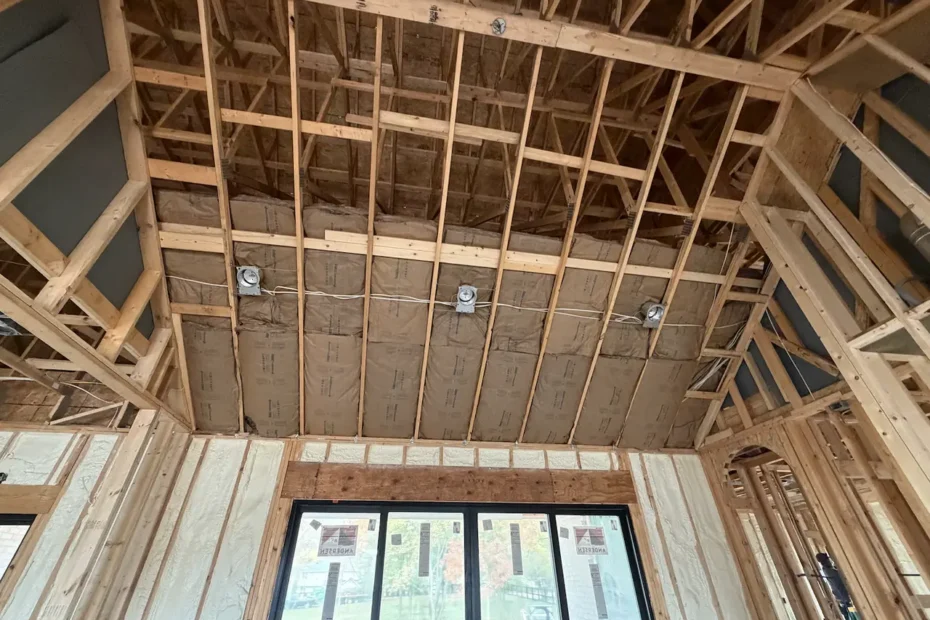
If you have cathedral ceilings — the kind that slope up with the roofline instead of having a flat ceiling with an attic above — you’ve got one of the most challenging insulation situations in residential construction. Contractors disagree on how to handle them, building inspectors flag them frequently, and homeowners who didn’t think about it during construction often end up dealing with drafts, moisture problems, and ice dams years later.
Here’s why cathedral ceilings are uniquely difficult, what can go wrong, and what the right approach looks like.
Why Cathedral Ceilings Are Different from a Standard Attic
In a standard attic situation, you have a clear separation: the living space below, an attic above with plenty of room for insulation, and a vented space between the insulation and the roof deck. That air gap allows any moisture that gets into the attic to escape, and it keeps the roof deck cold in winter — which prevents ice dams.
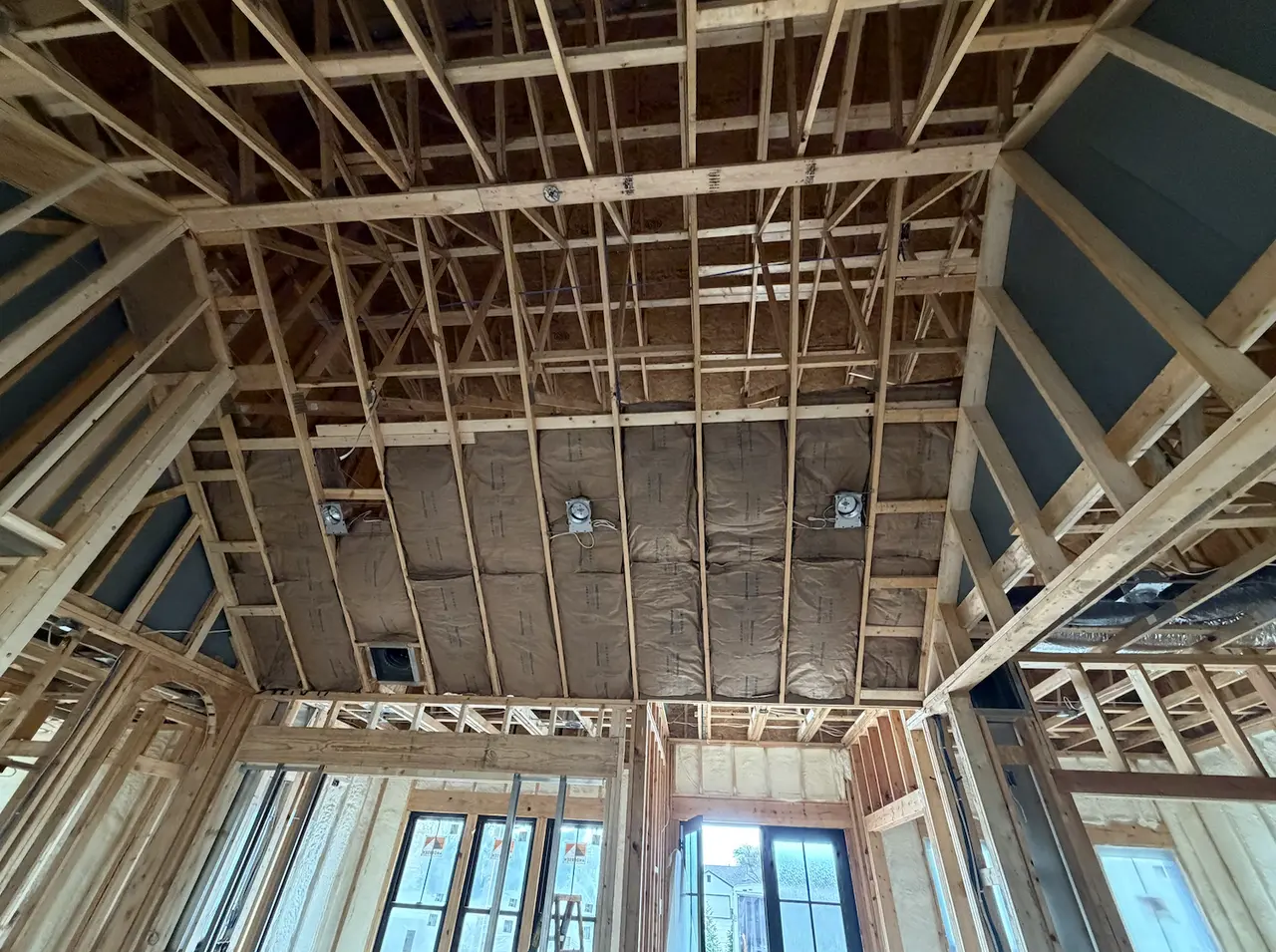
A cathedral ceiling eliminates all of that. The ceiling finish (usually drywall) is attached directly to the roof rafters, and the rafters are the only cavity you have to work with. In a typical house, those rafters are 2×8 or 2×10 lumber — meaning you have somewhere between 7.5 and 9.5 inches of space to work with. That’s it.
That shallow cavity creates three specific problems that don’t exist in a standard attic:
1. Not enough depth for adequate R-value. Indiana is in climate zone 5, which requires R-49 in the attic. Getting R-49 in a 9.5-inch rafter bay is physically impossible with most insulation materials. Even high-density spray foam at around R-6.5 per inch gives you roughly R-62 if you fill the entire cavity — but that leaves no room for ventilation baffles, which leads to problem two.
2. No room for a ventilation channel. Vented roof assemblies need an air gap between the insulation and the roof deck to allow moisture to escape and keep the deck cold. That typically means 1 to 2 inches of clearance. On a 2×8 rafter, taking 2 inches for ventilation leaves you only 5.5 inches for insulation — around R-20 with fiberglass batts. That’s dramatically under code and dramatically under what you need for comfort.
3. Moisture and condensation risk. Warm humid air from inside the house wants to move upward through the ceiling. In a standard attic with good air sealing, you stop it at the ceiling plane. In a cathedral ceiling, if any air gets into that rafter cavity and hits the cold roof deck, it condenses. Do that repeatedly over years and you end up with wet insulation, rotting sheathing, and mold — all hidden behind your ceiling finish where you won’t see it until the damage is significant.
The Two Ways to Handle a Cathedral Ceiling (and the Wrong Way)
There’s a right way to insulate a cathedral ceiling, and unfortunately there’s a much more common wrong way.
The wrong way is what gets installed in most production-built homes: fiberglass batts cut to fit between rafters, stuffed in with ventilation baffles stapled to the top. This approach technically checks a box at the building inspection, but it routinely underperforms. Fiberglass batts are not air barriers, so warm air moves freely through and around them. The baffles are often installed poorly, leaving no real ventilation channel. And the R-value is far below what Indiana winters demand.
The right way depends on whether you’re building new or retrofitting an existing ceiling.
For new construction or a gut renovation where the roof deck is exposed, the best approach is spray foam applied directly to the underside of the roof sheathing before the drywall goes up. Closed-cell spray foam at the roof deck creates an unvented, conditioned assembly — meaning the rafter cavity becomes part of the thermal envelope, there’s no need for ventilation baffles, and the foam handles both insulation and air sealing in one step. At 2 inches of closed-cell foam you have a vapor retarder. At 3 to 4 inches you’re approaching code-level R-values, and you can supplement with open-cell foam or rigid foam to hit your target.
For an existing cathedral ceiling where the drywall is already in place and the roof is intact, your options are more limited. You can inject foam through small holes drilled in the drywall or exterior siding. You can add rigid foam insulation to the exterior side of the roof deck during a re-roofing project — this is actually an excellent approach because it adds R-value above the sheathing without touching the interior. Or, if comfort and performance are the priority and the project budget supports it, removing the drywall to access and properly insulate the cavity is the most thorough fix.
What Goes Wrong When It’s Done Poorly
The failure modes for poorly insulated cathedral ceilings are predictable and consistent:
Ice dams. In Indiana winters, ice dams are almost always a sign of heat escaping through the roof — warming the snow above it, melting it, and refreezing it at the cold overhang. Cathedral ceilings with thin or poorly installed insulation are one of the primary culprits. The fix isn’t better gutters or more salting — it’s stopping the heat loss at the source.
Thermal striping. If you look at your cathedral ceiling in certain light and can see subtle parallel lines that match your rafter spacing, that’s thermal bridging. The rafters themselves conduct heat far better than the insulation between them, creating cold stripes across the ceiling in winter. Dense insulation and exterior continuous foam boards are the solutions.
Condensation and rot. This one takes years to show up, but when it does it’s expensive. Wet insulation loses most of its R-value. Wet sheathing delaminates. Wet rafters rot. By the time you notice staining on your ceiling, there’s often significant structural damage behind it.
The Honest Assessment
Cathedral ceilings are beautiful, but they don’t forgive poor insulation the way a standard attic does. A standard attic is forgiving — you can add more blown-in insulation on top of whatever is already there and improve performance fairly easily. A cathedral ceiling is a closed system. Whatever is in those rafter bays when the roof goes on is what you’re living with until you’re ready to do real work.
If you’re building new and know you want cathedral ceilings, discuss the insulation strategy with your contractor before framing begins. The difference in cost between doing it right from the start and fixing it later is substantial.
If you’re in an existing home with cathedral ceilings and you’re dealing with cold spots, ice dams, or high energy bills, an insulation assessment can tell you exactly what’s inside those rafter cavities and what your realistic options are. Not every situation requires a full tear-out — but you need an honest picture before you decide.